Hours, prices and access verified by the Alsace Wine Tours team — last checked 2026-09-20.
One castle on a ridge, one great museum in Colmar, and a string of walled
villages with vines against the last garden wall. Here is what each stop actually holds,
what it costs, and which are worth Alsace Wine ticket prices.
Château du Haut-Kœnigsbourg
The castle stands on a spur above the plain at Orschwiller, and on a clear day you can
see the Black Forest from its ramparts. It is the one paid gate on this route you may have
to buy for yourself, because most fares leave it out. Everything below is published by the
castle itself.
An adult self-guided visit is €12, €16 with the audio tour,
€8 for 6 to 17s and €30 for a family of up to four, two adults
at most. Under-6s go free and groups of twenty or more pay €8 a head. Entry is free on the
first Sunday of the month from November to March, on European Heritage Days and on Museum
Night. The castle takes the Pass'Alsace and the Museums-PASS-Musées.
What
Where
Adult
Hours
Château du Haut-Kœnigsbourg
67600 Orschwiller, above the plain
€12 self-guided, €16 with the audio tour
September and October 9:30am–6:00pm; November and December 9:30am–12:00 and 1:00pm–5:00pm; Mondays from 10:30am. Last entry one hour before closing
Musée Unterlinden
Place Unterlinden, 68000 Colmar
€14, reduced €12
Wednesday to Monday 9:00am–6:00pm, last entry 5:30pm. Closed Tuesdays
Mondays start late and the last hour is not yours.
The castle opens at 10:30am on Mondays rather than 9:30, and last entry is always an hour
before closing. It is shut on 1 January and on 25 and 26 December. Which tours carry the
ticket is set out on the visitor guide.
Getting there without a tour is easier than it looks. There are 150 free parking spaces
at the castle, six of them reserved, and coach parking beside them; the A35 leaves the plain
at exit 17 or 18. Without a car, shuttle line 500 runs from Sélestat SNCF station for
€3 a journey.
Inside, the climb is real: one listing puts the visit at 300 steps of different heights
and orientations, and there is no way round them. Allow an hour and a half if you want the
keep, the ramparts and the armoury rather than a quick loop.
Musée Unterlinden, Colmar
Unterlinden is Colmar's great museum, a 13th-century convent joined to a modern wing
across the square. You can visit Wednesday to Monday, 9:00am to 6:00pm, with last entry at
5:30pm; it closes on Tuesdays, 1 January, 1 May, 1 November and 25 December. You pay
€14 as an adult and €12 reduced.
No tour here includes it, and none of the days out of Colmar leaves you time for it. The
short ones are in the vines; the long ones are in four villages. Treat it as a half day of
its own, on a Tuesday when the museum is shut only if you want to be disappointed. The
open-top bus stops outside it, at the Colmar tourist office stop.
Colmar's Petite Venise
Petite Venise is the run of half-timbered houses along the Lauch at the bottom of Colmar's
old town, with flat-bottomed boats on the water in season. It is a fifteen-minute walk from
the station and costs nothing. One private listing names it as the sight its guests most
often ask for, which tells you how busy the little bridge gets in the afternoon.
If you are starting a wine day from Colmar, come here first thing instead. The Colmar
walking tour ends its circuit of the old town with a tasting, and the half day from Colmar
does not leave until 1:45pm, which leaves a morning free.
The villages, one by one
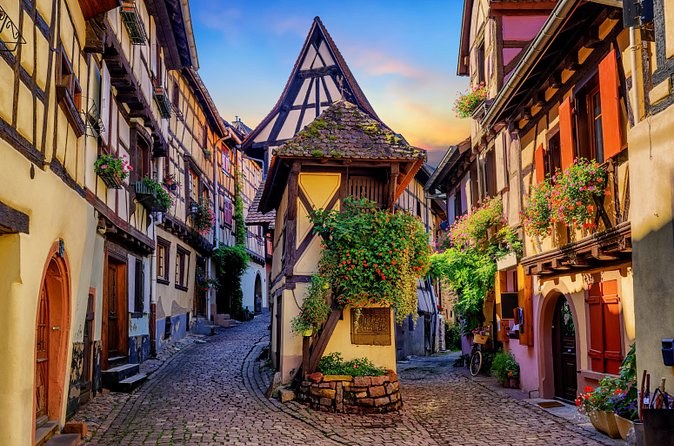
A cobbled village lane at sunset between half-timbered fronts, an old wine press under the gable in the middle of it
Eguisheim
Eguisheim is the one with the concentric rings: you walk in circles around the castle
at the centre rather than out from a square. It is listed by Les Plus Beaux Villages de
France, which also records its two grand crus, Eichberg and Pfersigberg. At the middle you
will find the chapel of the Château Saint-Léon, which holds the relics of Pope Leo IX, born
here, under a painted vault of seven scenes from his life.
Most day tours from Colmar stop here, and the open-top bus ends its loop at the town hall
car park. If you have longer, the marked Trois Châteaux walk climbs to the three ruined
towers above the village: 9 km and about three and a quarter hours, for the view back down
over the vines.
Riquewihr
Riquewihr sits inside its walls with a gate tower at each end of one long street, and it
has two grand crus, Schoenenbourg and Sporen. The Musée du Dolder fills the 13th-century gate
tower and leaves you on the rooftops. The Tour des Voleurs next to it was the village prison,
and your ticket takes in a 16th-century winegrower's house. If you book the guided
walk, this is where you meet.
Its wine trail leaves from Rue de la Piscine beside the Auberge du Schoenenbourg, and in
summer a grower sometimes walks it with visitors and pours at the end. Come early: this is
the busiest village on the route by a distance.
Ribeauvillé
Ribeauvillé is the bigger neighbour three and a half kilometres north, under three ruined
castles of its own. It is a working town rather than a showpiece, which is why you can still
get a table at eight o'clock. The wine days out of Colmar usually pair it with Riquewihr,
and the bus stops at its station. If you want its medieval Christmas market, note
that it runs on two weekends only.
Kaysersberg
Kaysersberg was voted the French public's favourite village in 2017, and the fortified
bridge over the Weiss under the castle ruin is what you came to photograph. Since the
communes merged it is part of Kaysersberg Vignoble, which has about 4,400 residents across
the valley. The bus stops at the Porte Basse, and you will find it on most village days out
of Colmar.
Hunawihr
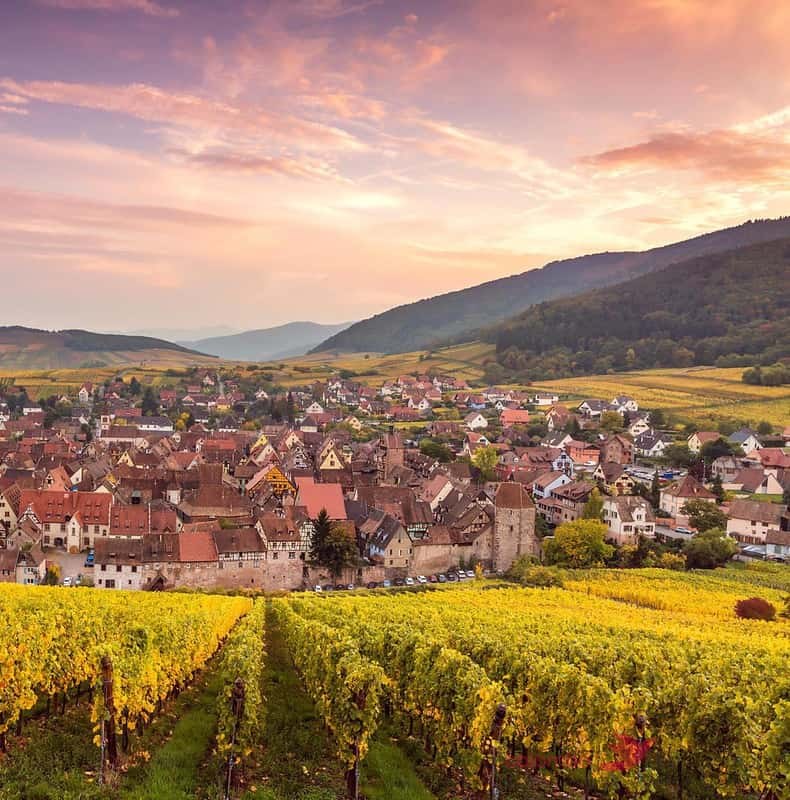
Hunawihr is small and stands in a full circle of vines, with a fortified church and
graveyard from the 15th and 16th centuries above it and 15th-century frescoes of Saint
Nicholas inside. Below the village, NaturOparC is a five-hectare park in old marshland
that began as a stork reintroduction centre and now also keeps otters and the European
hamster. The half day from Colmar drives through here.
Turckheim
Turckheim keeps three gates and a stretch of rampart you can walk, and the minibus day
from Strasbourg makes a point of the rampart passage. Its bus stop is the Porte de France.
In December the village runs an elves' Christmas market from 27 November to 30 December
2026.
Obernai
Obernai is the largest place on the northern half of the route, with about 12,600
residents, and the Ophorus half day out of Strasbourg calls here. It has a market square
with a six-bucket well, a belfry and a ring of walls, and enough hotels and restaurants to
make it a base rather than a stop.
Mittelbergheim
Mittelbergheim is a winegrowers' village at the foot of Mont Sainte-Odile, built around
courtyards rather than a street, and its grand cru is Zotzenberg. Behind the Renaissance town
hall you will find the Weinschlag, a wine and vineyard record going back to 1510, and the
village also keeps an 18th-century oil mill and a small winegrowing museum. Come in December
and you get a Christmas biscuit market with it.
The war cemetery above Sigolsheim
One castle-and-villages day from Colmar stops at the national war cemetery on the hill
above Sigolsheim, where the fighting for the Colmar pocket ended in the winter of 1944-45.
Sigolsheim is no longer a commune of its own — the government register now lists it inside
Kaysersberg Vignoble. It is a short climb from the car park, and the view over the vineyard
from the top is the reason the position was fought over.
Let somebody else do the driving between them
The village days link three or four of these in a day, and the tasting is already paid for on most of them.
The castle's own timeline is the short history of Alsace. A castle is first recorded on
the spur in 1147 and takes the name Koenigsbourg — royal castle — ten years later. Robber
knights destroy it in 1462; the Tiersteins rebuild it; a siege in the Thirty Years' War
burns it in 1633, and it stays a ruin for two centuries.
Sélestat buys the ruin in 1865 and gives it to Kaiser Wilhelm II in 1899, after Alsace
had been annexed to Germany in 1871. He commissioned the architect Bodo Ebhardt, whose
restoration ran from 1900 to 1908 and produced the castle you walk through today. In 1919
it became French state property, and since 2007 it has belonged to the department — the
Collectivité européenne d'Alsace since January 2021.
That back-and-forth is why the villages look German and the wine labels are French, why
your lunch is both, and why the grape names are spelled the way they are. Your guide will
tell you the story at least twice in a day, and you will enjoy it more for having heard it
once before you go.
Questions about the sights
How much is Haut-Kœnigsbourg on its own?
€12 for an adult self-guided visit, €16 with the audio tour, €8 for 6-17s and €30 for a family of up to four. Under-6s go free, and entry is free on the first Sunday of each month from November to March.
What time does Haut-Kœnigsbourg close?
6:00pm in September and October; 5:00pm in November and December, with a midday closure from 12:00 to 1:00. Last entry is always one hour before closing, and on Mondays the castle opens an hour later, at 10:30am.
What is at the Musée Unterlinden?
Colmar's main museum, on Place Unterlinden. It opens Wednesday to Monday from 9:00am to 6:00pm with last entry at 5:30pm, and an adult ticket is €14. It is closed on Tuesdays.
Can you see all the villages in one day?
Four is the realistic number, and the day tours out of Colmar prove it: Eguisheim, Kaysersberg, Ribeauvillé and Riquewihr, with a cave stop between them. Add Haut-Kœnigsbourg and something has to go, which is why the castle days visit fewer villages.
Where these facts come from
The castle's prices, hours, last entry, parking, shuttle and timeline are published by
the castle itself at haut-koenigsbourg.fr. The museum's are from musee-unterlinden.com. The
village detail comes from Les Plus Beaux Villages de France, which lists four of these villages. Kaysersberg's own valley tourist office and the French government's commune register, which publishes each commune's centre
supply the rest, and what each tour stops at comes from its listing.
A long day from Colmar with the castle ticket in the fare, three villages, the Sigolsheim necropolis and an hour at a winery. A French-speaking driver, with audio in twelve languages.
Eguisheim, Kaysersberg, Ribeauvillé and Riquewihr in a day, with pick-up in Colmar and seven seats. The stop at the cave is in the fare; the tasting there is bought on the spot.
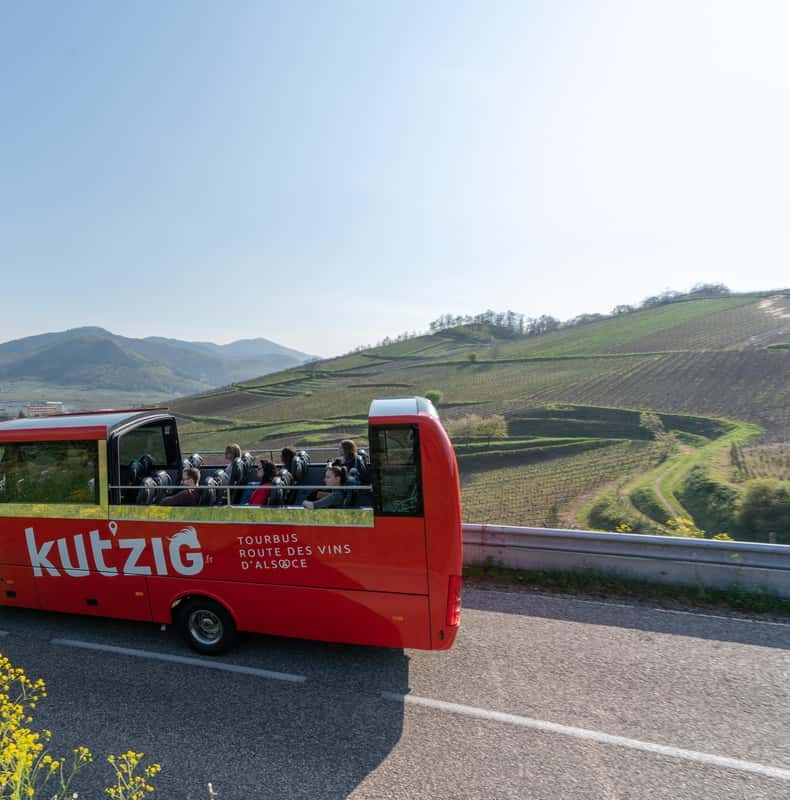
A day ticket on the open-top bus between six wine-route villages, 8:30am to 7:00pm, with an audio app. It carries you; the cellars and the tastings are yours to arrange.